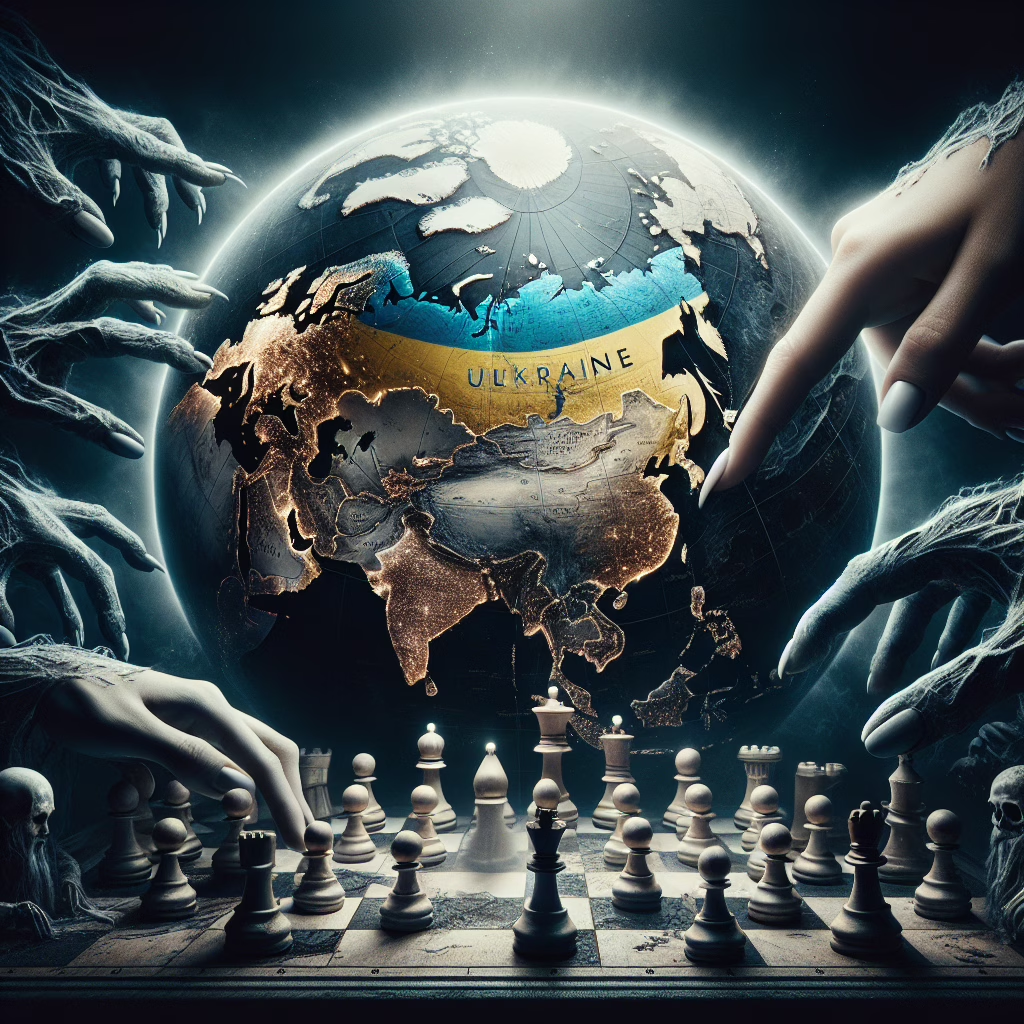
In 2025, the boundaries of gambling have extended far beyond traditional sports and racing events, venturing into the grim realities of global conflicts. The ongoing war in Ukraine, marked by widespread devastation and profound human suffering, has quietly morphed into a lucrative betting market on a global scale. Each shift at the frontline, each rumor of peace, and each potential escalation is now a tradable outcome for speculators.
For many Ukrainians, changes in territorial control spell disaster — evacuation, destruction, and loss. However, far removed from the war zones, these same events are perceived as volatile opportunities ripe for financial gain. Numerous markets now exist focusing on critical aspects of the conflict, such as whether a particular city will fall by a certain date, if ceasefires will last, or if the conflict will spread further. This has effectively converted the war into a financial instrument where uncertainty is an asset.
The implications are chilling. What amounts to an existential threat for millions is reduced by some to mere data points on a fluctuating graph, representing potential profits.
In November, the unsettling reality of this new betting landscape was highlighted when an unauthorized change to a well-respected war map suggested a sudden Russian advance in Myrnohrad. This alteration happened just minutes before a significant bet on the city’s capture was due to be settled. Although the change was quickly corrected, the incident had already led to financial payouts based on the erroneous information, underscoring the risk of manipulation when financial outcomes hinge on public data.
The potential for exploitation is evident. If battlefield maps can dictate financial gains or losses, they become targets for manipulation — through hacking or other forms of tampering.
Further controversy arose when an open-source intelligence project in Ukraine discovered its battlefield map embedded within a betting platform without consent. Originally designed to assist civilians in staying informed about danger zones, the map had unwittingly become a tool for bettors. The unauthorized use of the map for gambling purposes angered its creators, highlighting a new problem: as long as conflict data retains speculative value, it becomes nearly impossible to control its usage.
The rise of conflict as an asset class is evident in the billions now circulating in these war-related markets. Bets related to the Ukraine war alone have attracted over a hundred million dollars, with significant sums wagered on whether specific Ukrainian towns will fall, whether the war will extend into NATO territories, or the likelihood of nuclear escalation.
This isn’t a fringe activity; it’s a stark example of gambling on geopolitical turmoil — a trend magnified by lax regulations, blockchain technology, and a global thirst for prediction markets. The Ukraine war has been transformed into an “asset class,” thriving on the very uncertainty that brings suffering to so many.
Advocates for prediction markets argue that they can improve forecasting and drive accurate information dissemination. However, the Ukraine conflict reveals a darker truth: the perceived accuracy here relies on human catastrophe. Beyond the ethical questions, the influx of money risks eroding trust in open-source intelligence as individuals might be incentivized to distort information, spread false rumors, or exploit insider knowledge.
The ramifications extend beyond betting markets. Journalists, analysts, and governments rely on the same information to comprehend the conflict, and weaponizing this data for speculation threatens the integrity of public knowledge itself.
The thick fog of war is already a challenge; introducing financial speculation only deepens it.
Each time conflict advances, with territories shaded in red on maps, somewhere far from the devastation, someone calculates potential profits. They do so not out of allegiance to any side but because they timed their bets correctly. A city’s capture becomes a winning bet, a missile strike a payout, and a ceasefire a market-moving event. In this transformation, something essential is lost — empathy.
This new culture of gambling on geopolitical events questions whether anything, including sovereignty and civilian lives, is off-limits when framed as a tradable event. Should we gamble on everything?
The uncomfortable reality is markets rarely self-regulate. As long as events are measurable, unpredictable, and emotionally charged, traders will speculate. The pressing question is not if these markets will continue to grow, as they almost certainly will, but whether society accepts a world where war becomes entertainment, tragedy morphs into opportunity, and human suffering is reduced to a line on a price chart.
If boundaries aren’t drawn, markets will define them for us, and markets inherently lack compassion. The real bet is whether we still possess the capacity to draw those lines.

erik is an editorial byline used by Casino No Deposits for industry news coverage. Articles published under this byline are summarised from reporting by licensed gambling industry news sources and produced with AI assistance, then published against our editorial rules on accuracy, sourcing and tone. They are not first-hand reporting and do not contain personal player accounts. Our full process, including how bonus listings and ratings are maintained separately by our team, is documented in how we review casinos: https://casinonodeposits.com/how-we-review-casinos/
Topics: Ukraine · Crypto Gambling · Enforcement
Looking for somewhere to play? See our current no deposit bonus offers, updated with verified codes and full wagering terms.
 4.5/5
4.5/5MegawinEU Casino Review
Bonus Code: NDB10