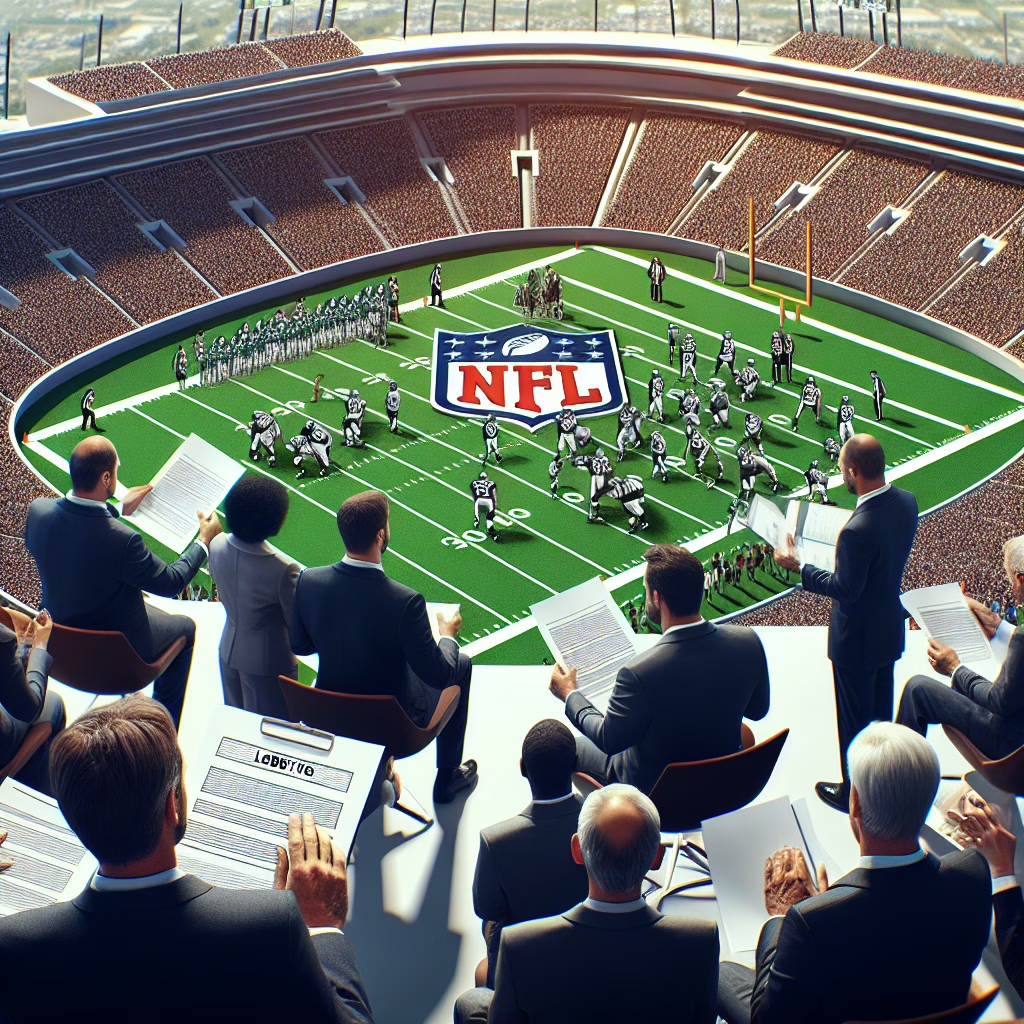
In December 2025, the NFL has made a significant push for U.S. lawmakers to impose stricter regulations on the rapidly expanding sports prediction markets, raising concerns that these markets, which facilitate trading of event-based contracts outside state gambling laws, may pose greater threats to the integrity of the game than traditional sports betting. This push was articulated in a written testimony to the House Committee on Agriculture, responsible for overseeing the Commodity Futures Trading Commission (CFTC).
Jeff Miller, NFL’s executive vice-president, expressed the league’s deep concerns over the proliferation of sports-related contracts on federally regulated prediction platforms operating nationwide, even in states that have not legalized sportsbooks. He emphasized that state gambling regulators collaborate closely with sports leagues to determine permissible bets and establish limits, but these protections are absent in prediction markets. Consequently, he urged Congress and the CFTC to restrict the most sensitive types of sports event contracts until a more robust consumer and integrity framework is established.
A jurisdictional clash has emerged as critics argue that prediction markets essentially function as alternatives to sportsbooks, particularly in states that do not authorize conventional wagering. The NFL singled out a recent market allowing users to bet on whether terms like “concussion protocol” or “roughing the passer” would be mentioned during game broadcasts. According to the league, bets linked to officiating or broadcast language are particularly sensitive, as they could raise questions about impartiality and potentially facilitate the misuse of inside information.
The scale of prediction platforms is another concern for the NFL. These platforms operate under federal derivatives rules in every state, while legal sportsbooks are licensed in only 39 states and the District of Columbia. Miller cautioned that, over time, the total volume on event contracts could surpass the activity at regulated books, remaining largely outside state control.
The disparity between federal and state oversight is clear: CFTC-regulated exchanges treat most prediction-market products as “event contracts” or derivatives, while state gambling commissions license and supervise retail and online sportsbooks. This discrepancy has prompted several state regulators, including those in Nevada, Illinois, Louisiana, and Washington, to challenge the distinction. They have issued opinions suggesting that sports event contracts resemble bets and that offering them without a sports wagering license might breach state laws. In some instances, these regulators have advised their licensees to exercise caution when considering partnerships with prediction platforms.
Advocates for prediction markets argue that the criticism overlooks the existing federal regulations. Responding to Miller’s testimony, the Coalition for Prediction Markets, representing major operators, likened the league’s critique to claiming “the stock market has no rules.” They highlighted CFTC’s surveillance, anti-manipulation provisions, and internal compliance systems, asserting that traders enjoy a different but not inferior set of protections compared to sportsbook customers.
The debate over prediction markets gained prominence during a congressional hearing where members of the House Agriculture Committee examined whether existing laws sufficiently differentiate between a legitimate event contract and a sports bet disguised as a derivative. For the NFL, achieving clarity is paramount. The league seeks to ensure that Congress unequivocally states that sports-linked event contracts cannot bypass state gambling protections, particularly in jurisdictions that have opted not to legalize betting altogether. Additionally, the NFL desires stricter limitations on markets related to officiating calls, injuries, and disciplinary actions, which it sees as particularly prone to manipulation.
On the other hand, prediction-market operators contend that many of these issues can be addressed within the current regulatory framework. They argue that implementing targeted restrictions—such as prohibiting markets on refereeing decisions, capping maximum exposure, or excluding certain player-level outcomes—would be a more balanced approach than shutting down entire platforms.
The CFTC is currently defending its authority in court, dealing with litigation over proposed election markets and broader questions about its ability to approve sports contracts. Any new guidance from Congress could significantly influence these cases and potentially establish a national standard for distinguishing when an event contract is treated as a derivative versus when it falls under state gambling regulations.
Meanwhile, the NFL remains actively engaged. Recent player betting scandals have heightened leagues’ sensitivity to products that could blur the lines between financial speculation and wagering on games. Miller communicated to lawmakers that the NFL is prepared to collaborate with both Congress and the CFTC to develop a tighter oversight framework. However, he also stressed that, from the league’s perspective, “doing nothing” is not an option as prediction markets continue to expand across all 50 states and major sportsbooks rush to incorporate similar products into their offerings.
How Congress decides to act will significantly impact the future landscape of U.S. sports wagering and whether prediction markets will become part of the regulated ecosystem or persist as a contested parallel track.

James Miller is an editorial byline used by Casino No Deposits for industry news coverage. Articles published under this byline are summarised from reporting by licensed gambling industry news sources and produced with AI assistance, then published against our editorial rules on accuracy, sourcing and tone. They are not first-hand reporting and do not contain personal player accounts. Our full process, including how bonus listings and ratings are maintained separately by our team, is documented in how we review casinos: https://casinonodeposits.com/how-we-review-casinos/
Topics: Louisiana · Illinois · Prediction Markets · Nevada · Licensing · Sports Betting
Looking for somewhere to play? See our current no deposit bonus offers, updated with verified codes and full wagering terms.
 4.5/5
4.5/5MegawinEU Casino Review
Bonus Code: NDB10