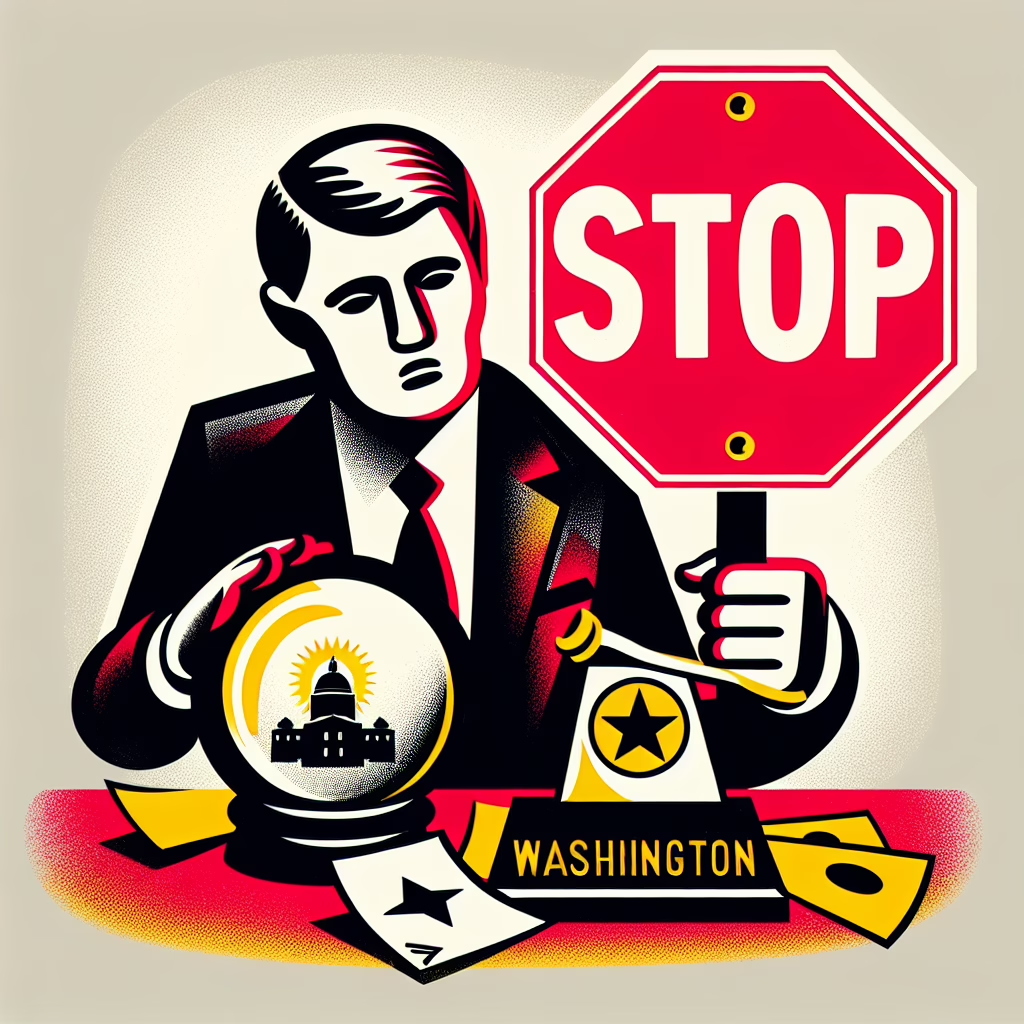
Washington State’s gambling authorities have issued a stern warning: online prediction markets are not legalized within its jurisdiction. This announcement adds to the mounting national debate on whether event-based contracts should be regarded as investment tools or as unlicensed sports betting. In a public notification released this month, the Washington State Gambling Commission (WSGC) stated that platforms allowing users to buy contracts on real-world outcomes are engaging in “unauthorized activity” as per state law. While the message is directed towards Washington residents rather than specific companies, it unmistakably signals platforms and licensed sportsbooks monitoring the federal discussions surrounding entities like Kalshi, Polymarket, and the recently launched Fanatics prediction app.
The WSGC clarified: contracts based on real-world events are not sanctioned. It specified in its advisory that “increased interest in prediction markets, which are online operators offering event-based contracts for purchase,” does not align with authorized gambling activities in Washington. The commission emphasized that only tribal casinos, which operate under tribal-state compacts, have the legal clearance to offer sports betting. This permission does not extend to online exchanges dealing in contracts tied to elections, sports, or other events. While acknowledging the ongoing litigation at both federal and state levels concerning the future of prediction markets, including those related to sports and political events, the commission promised to keep an eye on these proceedings and update the public following judicial decisions.
The emergence of Fanatics Markets—a new prediction app launched in partnership with Crypto.com and broker Paragon Global Markets—has introduced federally regulated event contracts across more than 20 states. However, Fanatics does not provide licensed sports betting in Washington, making the commission’s perspective particularly pertinent. States like Arizona, Illinois, and Nevada have cautioned licensees that providing sports-style event contracts in jurisdictions that categorize them as illegal sports betting could negatively impact their license reviews. Although Washington’s advisory stops short of threatening cross-border “good character” tests, it emphasizes activities “within Washington State.” Up to this point, the commission has refrained from issuing cease-and-desist orders against prediction platforms, yet its intentions are clear: state agencies are exploring their limits in countering federally regulated markets they deem as encroaching on their turf.
In the current U.S. context, most prediction-market platforms operate under CFTC-regulated “designated contract markets” that list event-based contracts, with Kalshi and Crypto.com’s DCM being prominent examples. From a federal viewpoint, these platforms are akin to derivatives exchanges offering financial products rather than sportsbooks. However, state regulators, especially in gambling-centric regions, are increasingly contesting this interpretation, especially when contracts involve sports scores, player statistics, or other traditional betting elements. Louisiana’s gaming board has already warned licensees that any contract allowing wagers on a sports outcome qualifies as sports betting under state law unless offered by a licensed sportsbook. Similar cautions have been issued in Arizona and Illinois.
Washington now positions itself alongside this contingent, even though it recognizes that the courts will ultimately determine the jurisdictional boundaries. The commission signaled its expectation for key legal precedents from ongoing cases in states like Massachusetts, Connecticut, and Nevada, reiterating its acknowledgment that prediction markets remain a contentious matter under litigation both federally and in other states.
Despite these developments, Washington has not yet followed up its advisory with an enforcement campaign, unlike Louisiana, which dispatched over 40 cease-and-desist letters to dual-currency sweepstakes casinos after a legislative ban attempt was vetoed. The Washington commission stresses that its statement on prediction markets is meant as public guidance rather than a legal move. Residents are advised that legal sports wagering is restricted to tribal casinos, using apps operational only on tribal lands, not the broader internet.
The larger debate centers on the purpose of prediction markets. Advocates maintain that markets tied to elections, economic indicators, or even pop culture events offer valuable information and risk management tools. Critics, however, argue that when these markets allow ordinary consumers to stake money on outcomes they might not fully understand, the resemblance to gambling is inescapable—irrespective of whether the resolution is processed via a futures exchange or a casino.
For now, Washington is firmly positioned on the cautious side of this debate. Prediction markets, as the commission iterates, are not recognized as authorized gambling. They are excluded from the compacted, tribal-operated sports betting framework. Unless altered by courts or Congress, that remains Washington’s standpoint. The question remains whether operators like Fanatics, Kalshi, and Polymarket can sustain a national business model within this fragmented landscape—welcomed by some states, rejected by others, and continuously embroiled in litigation.

Sarah Thompson is an editorial byline used by Casino No Deposits for industry news coverage. Articles published under this byline are summarised from reporting by licensed gambling industry news sources and produced with AI assistance, then published against our editorial rules on accuracy, sourcing and tone. They are not first-hand reporting and do not contain personal player accounts. Our full process, including how bonus listings and ratings are maintained separately by our team, is documented in how we review casinos: https://casinonodeposits.com/how-we-review-casinos/
Topics: Louisiana · Arizona · Massachusetts · Illinois · Sweepstakes Casinos · Prediction Markets
Looking for somewhere to play? See our current no deposit bonus offers, updated with verified codes and full wagering terms.
 4.6/5
4.6/5