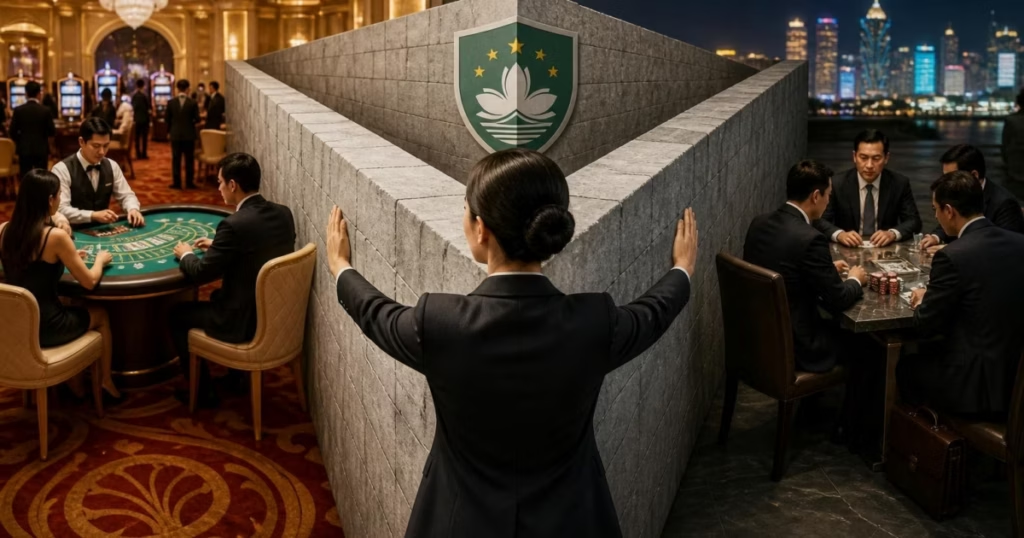
Macau’s Gaming Inspection and Coordination Bureau, known as the DICJ, has rejected a lawmaker’s call to reconsider rules governing gambling promoters, saying casino concessionaires and junkets have legally distinct functions rather than competing roles in the city’s VIP market. The response, issued in Macau in August by acting DICJ director Lio Chi Chong, matters because it signals that the regulator does not currently intend to alter the licensing, tax and commission framework introduced to place tighter controls on the junket sector.
The written reply addressed questions submitted by legislator Chan Hao Weng, who had argued that casino companies’ expansion of directly managed VIP services had reduced the business channels available to licensed gaming promoters. Chan asked the government to review restrictions that require each promoter to work with only one casino concessionaire and to examine the 5% tax applied to junket commission income.
Lio did not indicate that either request would lead to a policy change. Instead, the regulator reaffirmed its view that Macau’s six casino concessionaires are the only entities licensed to conduct casino gaming, while gaming promoters are permitted to recruit players and provide services connected with those customers under agreements with concessionaires.
The distinction is central to Macau’s post-reform controls over junkets, a sector that previously played a major role in serving high-value gamblers, particularly through rolling-chip arrangements. Under the current framework, promoters are not permitted to participate directly or indirectly in casino operations or share in casino gaming revenue. Their remuneration is based on commissions paid by the concessionaire with which they are affiliated.
According to the DICJ’s response, these legal boundaries mean that directly operated VIP businesses run by concessionaires should not be considered competitors of junkets. The bureau said promoters support casino operators by attracting and referring customers, while the operators remain responsible for gaming activity and the management of gaming facilities.
Chan had taken a different view of the commercial effect of those rules. He said the development of VIP programmes managed directly by concessionaires had narrowed the customer-acquisition channels available to promoters and created what he described as an uneven competitive environment. His comments point to an underlying tension in the market: although the law assigns separate functions to operators and promoters, both can seek to establish relationships with high-value customers.
The legislator cited DICJ figures showing that Macau had 29 licensed gaming promoters in July. That number was equal to 58% of the maximum of 50 promoters permitted under the framework set for 2027. The gap between the number of licences in force and the statutory ceiling suggests that the market remains substantially smaller than the sector’s historical scale, even though a limited number of licensed intermediaries continue to operate.
Macau’s current rules were shaped by the government’s effort to place the VIP segment under closer regulatory supervision. The system requires a gaming promoter to be associated with a single concessionaire, preventing promoters from simultaneously arranging business for multiple casino groups. The one-concessionaire rule is intended to make contractual accountability and regulatory oversight more direct, while reducing the scope for promoters to operate across several gaming companies.
For operators, the restriction can provide greater visibility over the promoters working on their behalf and over payments made for customer referrals. It can also limit the pool of promoters with which each concessionaire may engage, particularly if eligible promoters have already entered arrangements with other casino companies. For promoters, the rule concentrates commercial dependence on one casino group and reduces their ability to diversify their customer relationships across the market.
Chan proposed relaxing that exclusivity requirement, arguing that it could give gaming promoters access to a broader range of business opportunities. The DICJ did not endorse the suggestion. Lio’s response stressed that the existing separation of duties helps ensure promoters concentrate on player recruitment rather than gaming management, which remains the responsibility of the concessionaire.
The commission structure is another significant constraint on the sector. A dispatch effective from January 2023 limits promoter commissions to 1.25% of aggregate net rolling-chip turnover. The cap applies not only to direct commission payments but also to benefits supplied to promoters, whether directly or indirectly, by concessionaires or companies related to them.
Including indirect benefits within the cap is designed to prevent compensation arrangements from being shifted outside the formal commission rate. In practical terms, casino companies must consider the full value of payments and advantages provided to promoters when assessing compliance. The approach increases the importance of contractual documentation, accounting controls and internal monitoring for both sides of the relationship.
Gaming promoters must also pay a 5% tax on commission income and are not entitled to exemptions from that levy under the current system. Chan asked the government to reduce the rate, but the DICJ’s reply did not offer any commitment to revisit the tax. The bureau instead said it would continue to supervise concessionaires and promoters and ensure that tax payments are made in accordance with the law.
The combined effect of the commission ceiling, tax obligation and one-concessionaire rule is to define a more limited commercial model for licensed promoters than existed under earlier market arrangements. The rules do not prohibit promoters from conducting their permitted customer-introduction activities, but they prevent the closer operational and revenue-based relationships with casinos that the government has sought to avoid.
Lio said the policy was intended to guide the industry’s development in what the bureau described as a sound and reasonable direction and to avoid a return to excessive or disorderly expansion. The language indicates that the regulator continues to view restraint as a core objective of its junket policy, rather than treating the sector’s recovery in size as a standalone measure of market success.
That stance may disappoint promoters seeking broader access to concessionaires or lower operating costs. A reduction in commission tax, or permission to work with more than one casino operator, could improve commercial flexibility for licensed intermediaries. However, such changes could also increase supervisory complexity by creating more contractual links, payment arrangements and potential conflicts across the six-concessionaire market.
The DICJ’s position also provides clarity for casino operators that have invested in directly administered VIP customer services. By stating that operator-run programmes and promoter activities are not competing functions under Macau law, the regulator has reinforced concessionaires’ authority to manage high-value customer relationships themselves. The bureau has not suggested that direct VIP operations should be restricted to preserve business for junkets.
At the same time, the formal distinction may not remove all commercial friction. Promoters depend on their ability to source and maintain customer relationships, while casino groups can pursue those customers through their own programmes. The regulator’s answer addresses the legal allocation of responsibilities, but it does not resolve the business concern raised by Chan over whether promoters have sufficient scope to operate profitably within the current limits.
The issue is relevant beyond the relationship between casino groups and individual promoters because Macau’s licensed gaming market is structured around tightly controlled market access. Concessionaires carry the primary responsibility for gaming operations, customer controls and compliance with sector-wide requirements. Promoters operate as regulated intermediaries, rather than independent gaming businesses, and their ability to participate depends on adherence to the conditions set by the DICJ.
The regulator’s decision not to announce a review also underscores the importance of compliance planning. Concessionaires using promoters must remain within the commission cap and ensure that any associated benefits are properly accounted for. Promoters must maintain their licensed status, observe their single-concessionaire affiliation and meet their tax obligations. Breaches could expose parties to regulatory action and damage their ability to continue operating in a market where licences are limited.
The relatively low number of licensed promoters compared with the 2027 ceiling does not necessarily mean the government will encourage additional entrants. The DICJ’s response focused on supervision and orderly development rather than licence expansion. Any increase in the number of active promoters would remain subject to the licensing framework and to the commercial willingness of concessionaires to engage them.
Macau’s government will continue monitoring the junket sector and gaming policies in neighbouring jurisdictions, according to the DICJ. For now, the bureau has left the 1.25% commission limit, the 5% commission-income tax and the one-concessionaire requirement unchanged. Market participants will watch for any future regulatory review, but operators and promoters must continue to prepare for enforcement under the existing framework.

James Miller is an editorial byline used by Casino No Deposits for industry news coverage. Articles published under this byline are summarised from reporting by licensed gambling industry news sources and produced with AI assistance, then published against our editorial rules on accuracy, sourcing and tone. They are not first-hand reporting and do not contain personal player accounts. Our full process, including how bonus listings and ratings are maintained separately by our team, is documented in how we review casinos: https://casinonodeposits.com/how-we-review-casinos/
Looking for somewhere to play? See our current no deposit bonus offers, updated with verified codes and full wagering terms.