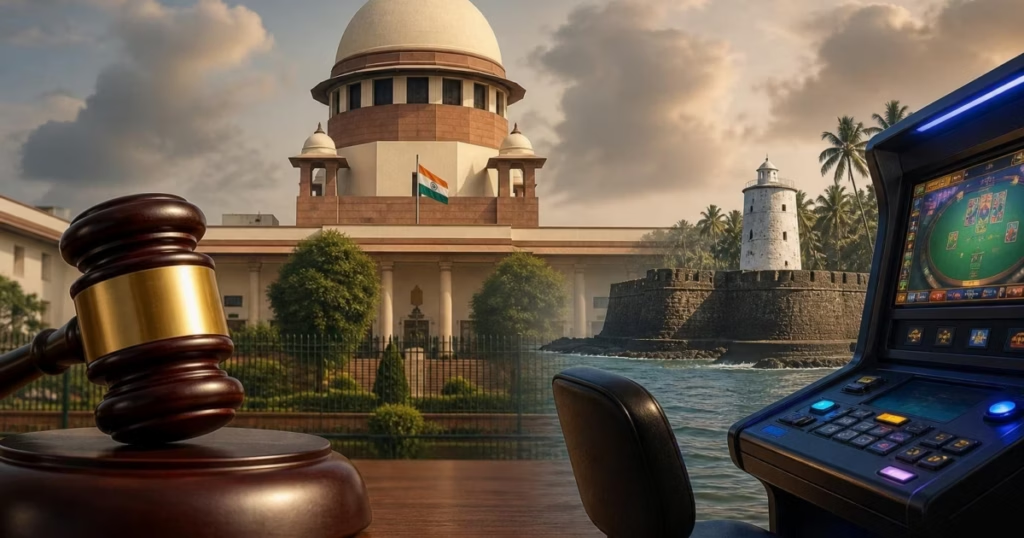
India’s Supreme Court has issued notices to the administration of the Union Territory of Dadra and Nagar Haveli and Daman and Diu in response to Delta Corp’s challenge over permission to operate slot machines and electronic amusement games at The Deltin hotel in Daman. The court action, reported on September 2, 2026, follows the Bombay High Court’s rejection of the company’s licensing claim in April and is significant because it could determine whether India’s largest listed casino operator can establish an electronic gaming operation outside its existing core markets.
The dispute concerns Delta Corp’s plan to install electronic games at its five-star Daman property, which the company developed with an investment exceeding Rs 450 crore. The operator has argued that it committed capital to the hotel after receiving indications from the local administration that its gaming plans could proceed, including a no-objection communication issued in 2007.
However, the Supreme Court’s decision to send notices to the Union Territory administration does not amount to a licence approval or an interim right to begin gaming operations. It allows the legal challenge to continue while the court considers Delta Corp’s Special Leave Petition against the Bombay High Court ruling.
According to the report, the next hearing has been listed for October 1, although the date was not independently confirmed. The central legal issue is whether provisions permitting slot machines under the Goa, Daman and Diu Public Gambling Act can be applied in Daman and, if so, whether the local administration must process or grant the operator’s application.
The statutory background dates to a 1992 amendment to the Goa, Daman and Diu Public Gambling Act. Delta Corp’s case is based on the position that the amendment legalising certain slot-machine activity was enacted for Daman as well as Goa. The company is seeking recognition that electronic gaming can be authorised at The Deltin under that framework.
The administration and the courts have so far not accepted the company’s licensing request. The Bombay High Court dismissed Delta Corp’s petition in April 2026, prompting the appeal to the Supreme Court. The precise scope of the High Court’s reasoning will be important in the next stage, particularly if the Supreme Court examines the territorial application of the gambling legislation and the legal status of administrative communications relied on by the company.
Daman’s administrative position has changed since the original legislation was introduced. Daman and Diu were combined with Dadra and Nagar Haveli in 2020 to form a single Union Territory. While historical gambling laws may continue to be relevant, the current administration retains a substantial role in licensing and enforcement. A favourable judicial finding on the interpretation of the legislation would therefore not necessarily remove the need for formal approval, compliance checks and operating conditions.
For Delta Corp, the case has commercial importance beyond the individual hotel. The company has historically generated the bulk of its revenue from land-based gaming, with its offshore and onshore casino operations concentrated in Goa and, to a lesser extent, Sikkim. Permission to run slot machines or related electronic games in Daman could give the group another physical gaming location and attach a gaming revenue stream to a property that is currently centred on hospitality.
The case also illustrates the constraints facing casino businesses seeking market access in India. Gambling regulation is fragmented across states and Union Territories, with permissions varying significantly by jurisdiction and by the type of activity involved. Even where legislation appears to permit particular forms of gaming, operators can face uncertainty over licensing procedures, local policy, tax treatment and the interpretation of older statutes.
That uncertainty is particularly relevant in Daman, where public gambling policy and local opposition could still affect implementation if Delta Corp succeeds in court. A ruling that the legal provisions extend to the territory would not compel authorities to ignore public-interest considerations or operational safeguards. Licensing bodies may still assess issues including access controls, surveillance, anti-money-laundering processes, responsible gambling procedures and the distinction between permitted electronic games and prohibited gambling formats.
The outcome could also influence the competitive landscape for physical casino operators. Delta Corp is already one of the few large listed groups with substantial exposure to licensed casino activity in India. A Daman licence would broaden its geographic footprint, but it would also underline the advantage held by companies able to sustain long legal and regulatory processes. Smaller prospective operators may face greater difficulty funding high-value hotel investments before licence certainty has been secured.
Conversely, a dismissal of the Special Leave Petition would leave The Deltin without the electronic gaming component contemplated by Delta Corp. The hotel would continue to operate as a hospitality asset, but its ability to generate returns from the original investment could be limited if the gaming facilities cannot be introduced. This is a material consideration given the company’s recent financial performance and its efforts to reorganise parts of its business.
Delta Corp reported consolidated revenue from operations of Rs 168.55 crore in the first quarter of fiscal 2027, down 8.5% from a year earlier. The company attributed pressure in part to weaker gaming performance. Casino gaming income declined about 12.08% to Rs 151.85 crore, compared with Rs 172.71 crore in the corresponding prior-year period.
Hospitality revenue moved in the opposite direction, rising approximately 37.92% to Rs 16.55 crore from Rs 12 crore. While the increase shows continued contribution from the group’s non-gaming properties, hospitality remains a smaller component of the business relative to casino operations. The Daman dispute therefore carries additional weight because it concerns whether a major hotel asset can participate in the segment that has historically generated most of the group’s income.
The company posted a consolidated net loss of Rs 212.42 crore for the quarter, compared with a profit of Rs 29.46 crore a year earlier. The result included an exceptional retrospective goods and services tax charge of Rs 306.73 crore. The tax burden has added to investor concern over the operating environment for gaming businesses, particularly after litigation over the application of GST to online gaming stakes.
In May 2026, the Supreme Court ruled that 28% GST could be imposed retrospectively on online bets, according to the report. Delta Corp has subsequently closed online gaming businesses it considered uneconomical, including Deltin Zuri in Goa and Deltin Denzong in Sikkim. The closures demonstrate how tax policy and judicial decisions can alter the viability of gaming operations even after businesses have been established.
The group’s emphasis has consequently returned to offline gaming, which has accounted for more than 80% of its revenue. Yet land-based expansion comes with its own regulatory limits. Goa and Sikkim have defined pathways for certain casino activities, while many Indian jurisdictions either prohibit gambling outright or have no established framework for commercial casinos. Daman could offer a strategic location because of its tourism infrastructure and proximity to western India, but its legal position remains unsettled.
Delta Corp is also progressing a separate corporate restructuring. Court-convened meetings of shareholders and creditors were held on August 13 to vote on a composite scheme of arrangement involving the demerger of its hospitality and real estate businesses. The proposed restructuring is not connected legally to the Daman licence case, although both matters may shape how investors assess the group’s underlying gaming, hotel and property assets.
Separating hospitality and real estate operations could provide clearer financial visibility between Delta Corp’s regulated gaming activities and its other businesses. At the same time, the Daman hotel’s value may partly depend on the eventual treatment of its electronic gaming application. A lengthy court process or an unfavourable ruling could complicate assessments of the property’s earnings potential, while a positive ruling would still leave administrative and operational requirements to be addressed.
The Supreme Court will next consider the Union Territory administration’s response and Delta Corp’s arguments over the applicability of the gambling law in Daman. Until the court issues further directions, The Deltin cannot treat the notice as market access or begin the proposed electronic gaming activity. The October hearing, if maintained, is expected to clarify whether the dispute proceeds to a fuller examination of the licensing framework or whether the Bombay High Court decision remains in force.

Sarah Thompson is an editorial byline used by Casino No Deposits for industry news coverage. Articles published under this byline are summarised from reporting by licensed gambling industry news sources and produced with AI assistance, then published against our editorial rules on accuracy, sourcing and tone. They are not first-hand reporting and do not contain personal player accounts. Our full process, including how bonus listings and ratings are maintained separately by our team, is documented in how we review casinos: https://casinonodeposits.com/how-we-review-casinos/
Looking for somewhere to play? See our current no deposit bonus offers, updated with verified codes and full wagering terms.