
Malaysian gaming equipment supplier RGB International said on September 3 it expects a stronger second half of 2026, as it works to complete planned machine deliveries, relocates equipment within the Philippines and awaits the outcome of a Macau supply tender. The outlook matters because the company’s recovery depends on improving margins after weaker quarterly profit, while any Macau contract would be tied to the territory’s tighter technical requirements for electronic gaming machines.
RGB’s management set out the outlook following second-quarter results that showed revenue growth but a decline in net profit. The company is targeting deliveries of 3,000 gaming machines during 2026 and said roughly 1,700 units remain to be delivered in the second half.
Chief operating officer for leisure Chuah Eng Meng and executive director Chuah Hui Jing discussed the group’s plans with Malaysian business publication The Edge. Their comments point to a strategy based on several separate initiatives rather than a single confirmed source of earnings: equipment sales, technical support and management operations, and digital services for Philippine integrated resorts.
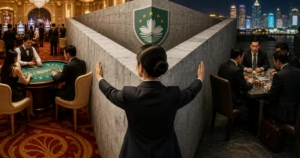
The potential Macau opportunity remains uncertain. RGB submitted a tender in August to supply a major casino operator in the Chinese special administrative region, according to management. The bidding process was expected to conclude in the third quarter, with deliveries potentially beginning in the fourth quarter should the company secure the contract.
Neither the customer nor the prospective value of the tender has been disclosed. RGB also has not said how many machines may be involved, what products have been proposed, or whether it is competing against other suppliers for all or only part of the replacement programme.
The tender is associated with a broader replacement cycle in Macau, where casinos are adapting electronic gaming machines to revised technical standards. Such upgrades can create equipment demand for suppliers, but they also involve procurement reviews, regulatory approvals, installation planning and potentially extended implementation schedules. The replacement process at the unnamed casino is expected to be phased over one to two years as gaming floors are upgraded.
For RGB, a successful tender would provide access to a market where casino operators are generally required to maintain compliance with detailed equipment, testing and operational standards. However, submitting a bid does not guarantee market access or an order, and the eventual timing of revenue recognition would depend on the contract structure, the operator’s floor upgrade schedule and the pace of machine deployment.
Macau remains a significant regional casino market, but supply opportunities are shaped by a concentrated customer base and close regulatory oversight. Gaming concessionaires have continued to adjust their properties and equipment portfolios following the renewal of casino concessions and the implementation of wider regulatory changes in recent years. Equipment suppliers seeking orders in the jurisdiction must therefore navigate not only commercial competition but also product certification, technical specifications and installation requirements.
RGB’s more immediate focus is the completion of its 2026 delivery target. Management said the company intends to ship the remaining 1,700 machines needed to reach its 3,000-unit objective. The extent to which those deliveries translate into improved profit will depend on pricing, financing arrangements, product mix and the cost of meeting customer requirements.
The issue of margins was prominent in the company’s second-quarter financial performance. RGB reported net profit of MYR10.33 million, or about US$2.45 million, for the quarter, down 26.3% from a year earlier. Revenue rose 15% to MYR109.63 million, or approximately US$26 million.
The contrast between higher revenue and lower profit reflected pressure in the sales, services and marketing division. RGB attributed the lower profit largely to reduced margins after it offered discounts and longer payment terms for bulk gaming-machine orders from customers in the Philippines.
Extended payment arrangements can help suppliers secure volume orders, particularly where operators are managing capital expenditure and cash flow. They can also delay cash collection and limit profitability if discounts are significant. For a company relying on a substantial delivery programme in the second half, investors will be watching whether future orders carry more favourable commercial terms.
Chuah Hui Jing said the discounting and payment arrangements were confined to 2026 and were not expected to become a standard feature of the company’s business. That position suggests RGB expects its normal margin profile to improve after the current sales cycle, although the company has not provided detailed guidance on expected profitability or cash-flow effects for the remainder of the year.
The second major element of the company’s recovery plan concerns its technical support and management, or TSM, operations in the Philippines. Management said the segment may have reached its low point after underperforming outlets affected results.
RGB is moving machines away from loss-making Philippine venues to locations that are generating stronger returns. The company said it had obtained the necessary regulatory approvals for the relocations. That approval process is material because gaming-machine transfers can require regulatory scrutiny depending on the operating model, the status of the venue and the equipment involved.
The plan is designed to raise the utilisation and returns of assets already in the field, rather than relying entirely on new machine sales. If the replacement locations perform as expected, the relocation programme could support a recovery in TSM earnings during the second half. Yet the outcome will depend on customer traffic, venue economics, local competition and continuing compliance with Philippine gaming rules.
The Philippine market has been an important commercial base for RGB, particularly through machine supply and service activities. It is also a market where operating conditions can differ sharply between locations. Moving equipment from lower-performing sites may improve the company’s portfolio, but it does not remove the broader risks associated with venue performance, regulatory changes and customer concentration.
TSM arrangements can provide recurring income compared with one-off equipment sales, but they can also expose suppliers to operating volatility when the machines are deployed in weaker locations. RGB’s decision to reposition units indicates management is seeking to reduce that exposure. The company has not disclosed the number of machines being relocated, the affected outlets or the expected financial contribution from the changes.
Beyond land-based equipment and services, RGB is developing a digital offering aimed at Philippine integrated resort operators. The proposed business would include game content, aggregation services and white-label managed services. Management said it had submitted a bid to one integrated resort and was in extensive discussions, while preliminary talks were taking place with two further resorts.
No agreement has been confirmed, and the company did not identify the resorts involved. The initiative is therefore at an exploratory and commercial negotiation stage rather than a completed market launch. RGB expects the business to begin contributing to group earnings within one to two years if the projects proceed.
Under the white-label managed-service structure described by management, RGB could receive a revenue share of 20% to 30%. Such models can offer suppliers an ongoing participation in digital gaming revenue, but the final economics would depend on contract terms, operating costs, player acquisition arrangements, technology performance and regulatory permissions.
Digital gaming services for integrated resorts also carry a different compliance burden from conventional machine supply. Operators and service providers may need to address technology controls, responsible gambling measures, data handling, payment processes, game approvals and reporting obligations. The commercial opportunity is therefore subject to both contract negotiations and the relevant regulatory framework.
The company’s second-half expectations consequently rest on activities at differing levels of certainty. Delivering the remaining machines under its annual target is an existing operational objective. The Philippine TSM relocation programme is under way after regulatory approvals. The Macau tender, meanwhile, remains subject to a customer procurement decision, while the digital projects are still in bid and discussion phases.
This mix may reduce reliance on any single market, but it also complicates forecasts. A Macau equipment order could take time to roll out because it is linked to a phased casino-floor upgrade. Philippine machine sales could continue to face margin pressure if commercial concessions are needed to win bulk business. Digital services may require a longer development period before becoming material to earnings.
For operators, RGB’s plans illustrate how suppliers are responding to demand for compliant replacement equipment and to the increasing integration of technology services into casino operations. For players, the direct effects are likely to be limited, although floor upgrades and machine relocation can alter the availability and mix of gaming products at individual venues.
Regulators in Macau and the Philippines will remain relevant to each component of the strategy. Macau’s technical standards underpin the replacement cycle that has created the tender opportunity. Philippine regulatory approvals have enabled the TSM relocation plan, while any expansion into managed digital services would require operators and suppliers to maintain the applicable licensing and compliance arrangements.
RGB is expected to monitor the Macau tender outcome during the third quarter, with potential deliveries from the fourth quarter if it wins the contract. Management will also need to complete the remaining 2026 machine deliveries, assess the performance of relocated Philippine machines and continue negotiations with integrated resorts before the proposed digital business can make a measurable contribution.

Sarah Thompson is an editorial byline used by Casino No Deposits for industry news coverage. Articles published under this byline are summarised from reporting by licensed gambling industry news sources and produced with AI assistance, then published against our editorial rules on accuracy, sourcing and tone. They are not first-hand reporting and do not contain personal player accounts. Our full process, including how bonus listings and ratings are maintained separately by our team, is documented in how we review casinos: https://casinonodeposits.com/how-we-review-casinos/
Looking for somewhere to play? See our current no deposit bonus offers, updated with verified codes and full wagering terms.
 4.5/5
4.5/5MegawinEU Casino Review
Bonus Code: NDB10