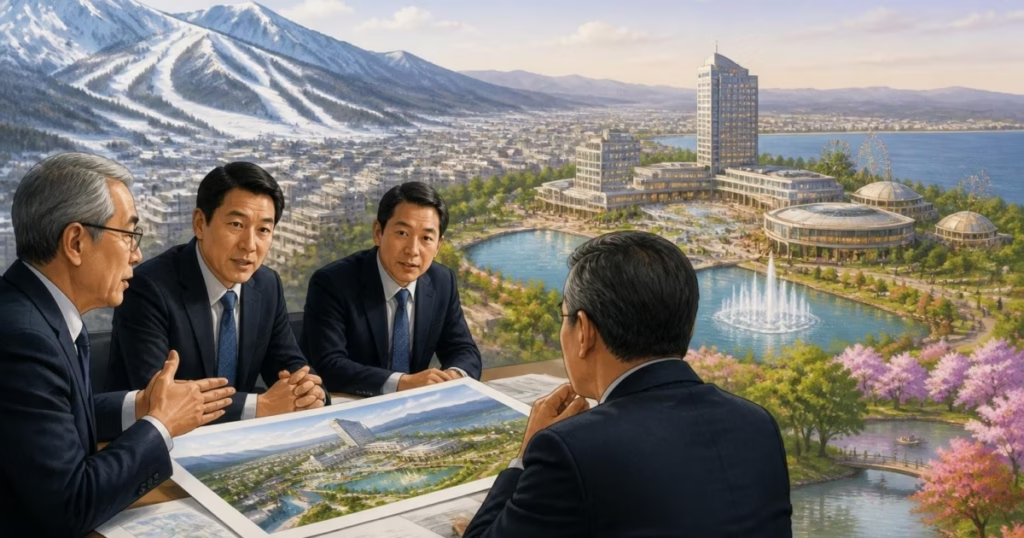
Eight business organisations in Japan’s Hokkaido prefecture are scheduled to ask Governor Naomichi Suzuki on September 8 to accelerate preparations for a potential integrated resort bid in the national application round planned for 2027. The request is commercially significant because it would press the prefectural government to make an early policy decision on a casino-resort project, allowing enough time for investor engagement, site selection, regulatory planning and local consultation before the application deadline.
The Hokkaido Economic Federation is among the organisations expected to submit the formal request, according to reporting by the Hokkaido Shimbun. The planned submission will coincide with the opening day of the prefectural assembly’s third regular session, placing the issue before elected representatives as well as the governor’s administration.
The move would be the first formal approach on an integrated resort project from Hokkaido’s business community since November 2019. That earlier request came shortly before Suzuki said the prefecture would not participate in Japan’s first national selection process for casino-linked integrated resorts.
At the time, Hokkaido withdrew from consideration largely because the local government said it needed more time to address concerns surrounding environmental assessments and the development framework. The decision ended what had been a closely watched potential bid, with the Tomakomai area regarded as a possible host location. Tomakomai is an industrial port city on Hokkaido’s south-central coast and has continued to feature in discussions about a future prefectural proposal.
The central government is expected to accept applications for a second integrated resort selection round between May 6, 2027 and November 5, 2027. Business representatives are seeking action well before that period begins, reflecting the substantial preparatory work required for a submission under Japan’s Integrated Resort Implementation Act.
A prefectural application would require a host municipality, a private-sector operating partner and a detailed area development plan. It would also need to demonstrate funding arrangements, responsible gambling measures, anti-money-laundering controls, transport capacity, disaster planning and the expected economic contribution to the region. The national approval process is designed to assess not only a project’s commercial viability but also whether local authorities can supervise casino operations and manage their wider social effects.
The business groups’ intervention indicates concern that Hokkaido could lose time if the prefecture delays a decision on whether to pursue market access. Local political timing may add to that concern, as a gubernatorial election is expected next spring. Any commitment to a casino resort is likely to attract scrutiny during an election period, particularly given the long-term land use, infrastructure spending and public-policy commitments associated with such developments.
Last month, Hokkaido said that three overseas casino operators and 12 Japanese companies had responded to questionnaires intended to assess investor interest in the prefecture as an integrated resort location. The exercise did not amount to a formal request for proposals or a licensing process, but it offered an initial indication that companies may be willing to examine commercial opportunities in the region.
The identities of the overseas operators were not disclosed in the information cited by local reports. Their participation is nonetheless relevant because Japan’s legal framework requires an integrated resort to be developed with an experienced private operator capable of meeting strict compliance, financial and operational standards. International groups have generally sought clarity on land availability, local political support, visitor projections and the timing of national approval before committing substantial resources to Japanese projects.
Hokkaido’s appeal to potential investors rests partly on its position as a major domestic tourism destination, with winter sports, natural attractions and international air connections. However, a prospective resort would face commercial constraints that differ from those in larger urban markets. A Tomakomai development would need to establish its ability to attract visitors year-round, provide sufficient transport connections and coexist with the prefecture’s environmental and regional development priorities.
The market backdrop is also shaped by the limited number of integrated resort licences expected to be available nationally. Japan’s first approved project is MGM Osaka, a JPY1.51 trillion development being built on Yumeshima, an artificial island in Osaka Bay. MGM Resorts International is developing the project with Japanese partners, and the resort is scheduled to open toward the end of 2030.
The Osaka project remains the only integrated resort to have secured national approval. Its progress has provided a reference point for other local governments, while also illustrating the scale and complexity of the approval process. The project involves large infrastructure commitments, a lengthy construction timetable and extensive supervision requirements. For Hokkaido, a 2027 application would therefore represent the beginning of a multi-year development and regulatory process rather than an immediate route to casino operations.
The limited experience of the first application round has also shown that local interest does not necessarily result in approval. Nagasaki prefecture’s proposed integrated resort project, centred on the Huis Ten Bosch area, was not selected when the initial national process concluded in December 2023. The outcome highlighted the importance of documentation, financing and the central government’s assessment of project sustainability.
Nagasaki is again part of the broader discussion over regional integrated resorts. This week, Omura city in Nagasaki prefecture held the first meeting of the Omura Bay Green IR Feasibility Study Promotion Council, a body established to examine whether an integrated resort concept could be viable in the area. The council will also consider entertainment and tourism facilities that do not depend solely on casino gaming.
Omura Mayor Hirofumi Sonoda, who is a member of the study group, said the council would examine the feasibility of integrated resorts outside metropolitan areas and assess other forms of entertainment. The body aims to prepare a basic regional concept and develop proposals for the national government concerning the Integrated Resort Act.
According to material reviewed by local industry reporting, the council intends to consider whether certain rules on facility scale could be adjusted to make regional developments more practical. Such proposals would concern the legislation governing the integrated resort framework rather than an immediate application for approval. Any change to statutory requirements would depend on action by the national government and would likely involve further policy and regulatory debate.
Omura cannot submit an integrated resort application independently because it is not a prefecture or a government-designated city with the authority to seek national approval. It would need Nagasaki prefecture to support and lead any future application. The city’s feasibility work therefore remains preliminary, particularly following Nagasaki’s unsuccessful first-round bid.
For Hokkaido, the immediate issue is whether the prefecture will respond publicly to the business groups’ request and establish a timetable for further work. A commitment to explore a bid would not itself resolve questions around host-site selection, environmental review, resident consent or the choice of an operator. Those matters could become more difficult if political support is divided or if potential developers demand greater certainty before advancing to a formal procurement process.
Opponents and cautious observers may also question whether a regional integrated resort can meet the government’s tourism and economic objectives without placing excessive reliance on casino revenue. Japan’s regulatory system limits domestic access through entry fees and visitation controls, while operators must comply with extensive measures on problem gambling, customer identification and financial crime prevention. These protections increase compliance costs and may affect revenue assumptions compared with other Asian casino jurisdictions.
Supporters, including the Hokkaido business groups, are likely to frame an application around tourism demand, employment, convention business and investment in surrounding infrastructure. Whether those benefits can be demonstrated convincingly will be central to any future prefectural plan. The national process requires local governments to show that resort development supports broader regional policy rather than functioning primarily as a gambling venue.
The September 8 submission is expected to test the Suzuki administration’s willingness to set out its position before the assembly session and the anticipated gubernatorial campaign. Hokkaido will need to decide whether to launch more detailed consultations and investor processes in time for the May-to-November 2027 application window, while Omura’s council is expected to continue its feasibility review and develop its recommendations on regional resort rules.

Official editorial account. Posts here are written by the CasinoNoDeposits team and cover bonus terms, wagering conditions and offer changes.
Looking for somewhere to play? See our current no deposit bonus offers, updated with verified codes and full wagering terms.
 4.5/5
4.5/5MegawinEU Casino Review
Bonus Code: NDB10