
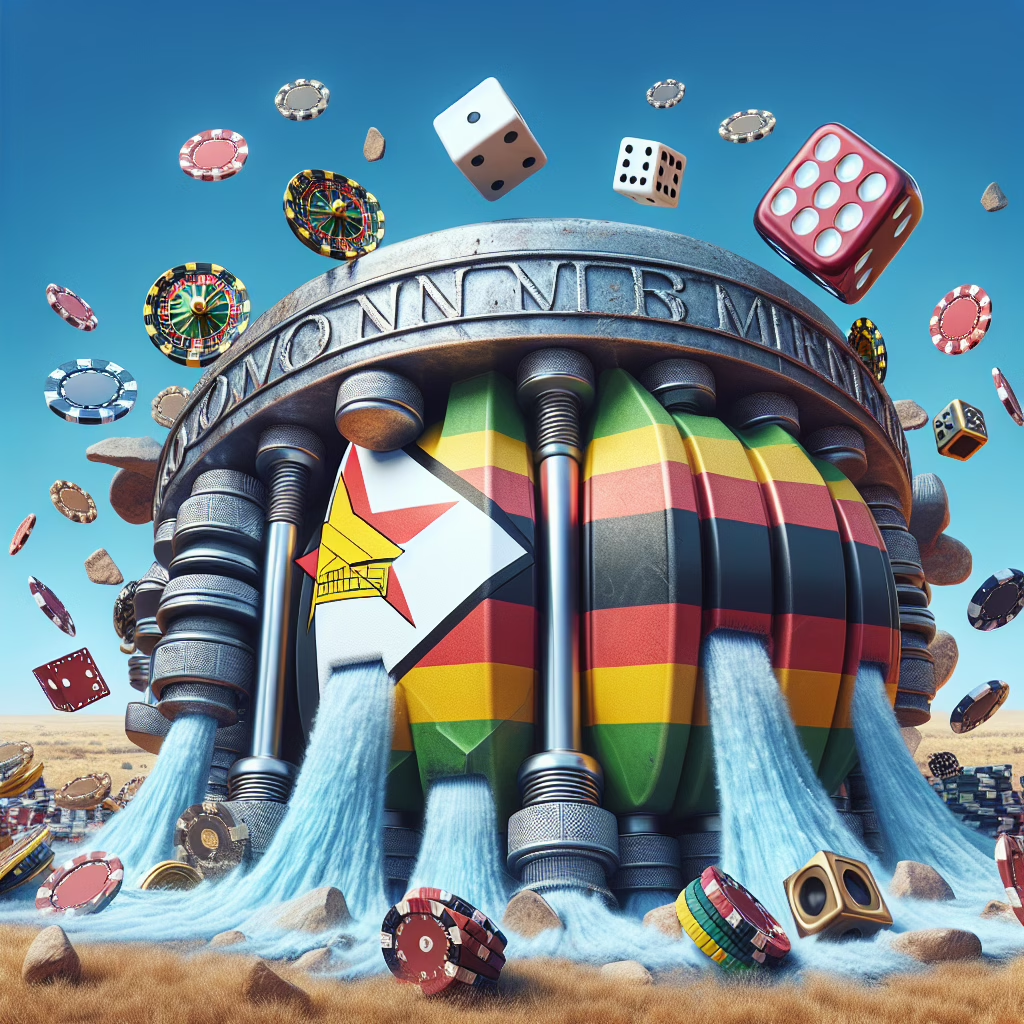
In early November 2025, Zimbabwe’s government found itself under increasing pressure from opposition parties and civic groups to address perceived inadequacies within its gambling laws. Critics argue that the current system disproportionately favors international gambling operators, while local communities and workers see little to no benefit. This mounting dissatisfaction has catalyzed a call for comprehensive reform and stronger consumer protections.
The debate over Zimbabwe’s gambling regulations has gained momentum in the National Assembly, with opposition figures like Rise Mzansi vocalizing their concerns. Mzansi emphasized the urgent need for reform by highlighting the vulnerabilities exposed in the gambling sector. His proposal includes seven essential reforms aimed at protecting at-risk groups from the harms of online gambling while also tackling the widespread issue of insufficient industry oversight.
However, there is significant division among Zimbabwe’s political factions regarding the extent of the proposed reforms. The uMkhonto weSizwe (MK) party has taken a hardline stance, advocating for a complete ban on gambling advertising. On the other hand, the Economic Freedom Fighters (EFF) suggest a more nuanced approach, proposing the prohibition of sports sponsorships by gambling entities. The EFF has accused other parties of accepting contributions from offshore online gambling companies, noting that these funds often fail to benefit local communities.
The topic of sponsorships and exploitation has also come under intense scrutiny, particularly within the realm of sports. EFF member Sinawo Thambo has been outspoken about the moral implications, arguing that gambling sponsorships exploit football, which is immensely popular among Zimbabwe’s lower-income communities. He noted that such sponsorships are conspicuously absent in sports like cricket, rugby, or swimming, which are perceived as more affluent.
Thambo’s perspective resonated with many Zimbabweans, who see the encroachment of gambling advertisements in economically disadvantaged areas and during football broadcasts as a growing concern. Meanwhile, MK’s Visven Reddy shifted the focus to the industry’s workforce. He criticized the system for allowing foreign owners to prosper while local employees remain undervalued and underpaid. Reddy described this as “modern slavery wearing a suit and a tie,” a comment that echoes the broader sentiment of discontent among the populace.
The call for action does not stop at advertising and labor conditions. There is a growing demand for the government to establish regulations that limit foreign ownership, enhance licensing standards, and improve working conditions for those employed in casinos and betting establishments. Earlier in the year, the Zimbabwean government took minor steps toward reform by prohibiting police officers from entering betting shops in uniform, a symbolic gesture to preserve the integrity of law enforcement amid rising concerns about gambling practices.
Yet, critics argue that such measures fall short of addressing the root issues. Without a robust framework for monitoring online gambling, enforcing advertising restrictions, and ensuring equitable taxation, these critics believe the industry will continue operating within legal loopholes. The opposition’s viewpoint is clear: symbolic actions are insufficient for meaningful change.
This push for reform is not occurring in isolation. Across the African continent, a trend towards tighter gambling regulations is emerging. In Kenya, the Betting Control and Licensing Board has recently prohibited celebrities and influencers from participating in gambling advertisements, aiming to shield young people from potential exposure. Similar discussions are currently taking place in South Africa and Nigeria, highlighting a regional movement towards more stringent controls.
For Zimbabwe, the debate extends beyond gambling. It raises fundamental questions about the flow of money, protection of its citizens, and ensuring that local communities are not marginalized. As the pressure for reform intensifies, the Zimbabwean government faces a critical decision: continue with incremental and patchwork fixes, or embark on a comprehensive overhaul towards a modern system that balances economic potential with accountability.
In this context, gambling in Zimbabwe often represents a double-edged sword, embodying both aspirations and obstacles. The central question remains: can effective regulation achieve fairness, or will entrenched practices persist unchallenged, benefiting only a select few while the majority continue to struggle? As this issue unfolds, the nation’s leadership is being tested on its willingness and ability to enact meaningful change that aligns with the broader regional shift towards accountability and fairness in the gambling industry.

erik is an editorial byline used by Casino No Deposits for industry news coverage. Articles published under this byline are summarised from reporting by licensed gambling industry news sources and produced with AI assistance, then published against our editorial rules on accuracy, sourcing and tone. They are not first-hand reporting and do not contain personal player accounts. Our full process, including how bonus listings and ratings are maintained separately by our team, is documented in how we review casinos: https://casinonodeposits.com/how-we-review-casinos/
Topics: Kenya · Nigeria · South Africa · Licensing · Gambling Taxes · Enforcement
Looking for somewhere to play? See our current no deposit bonus offers, updated with verified codes and full wagering terms.
 4.6/5
4.6/5